
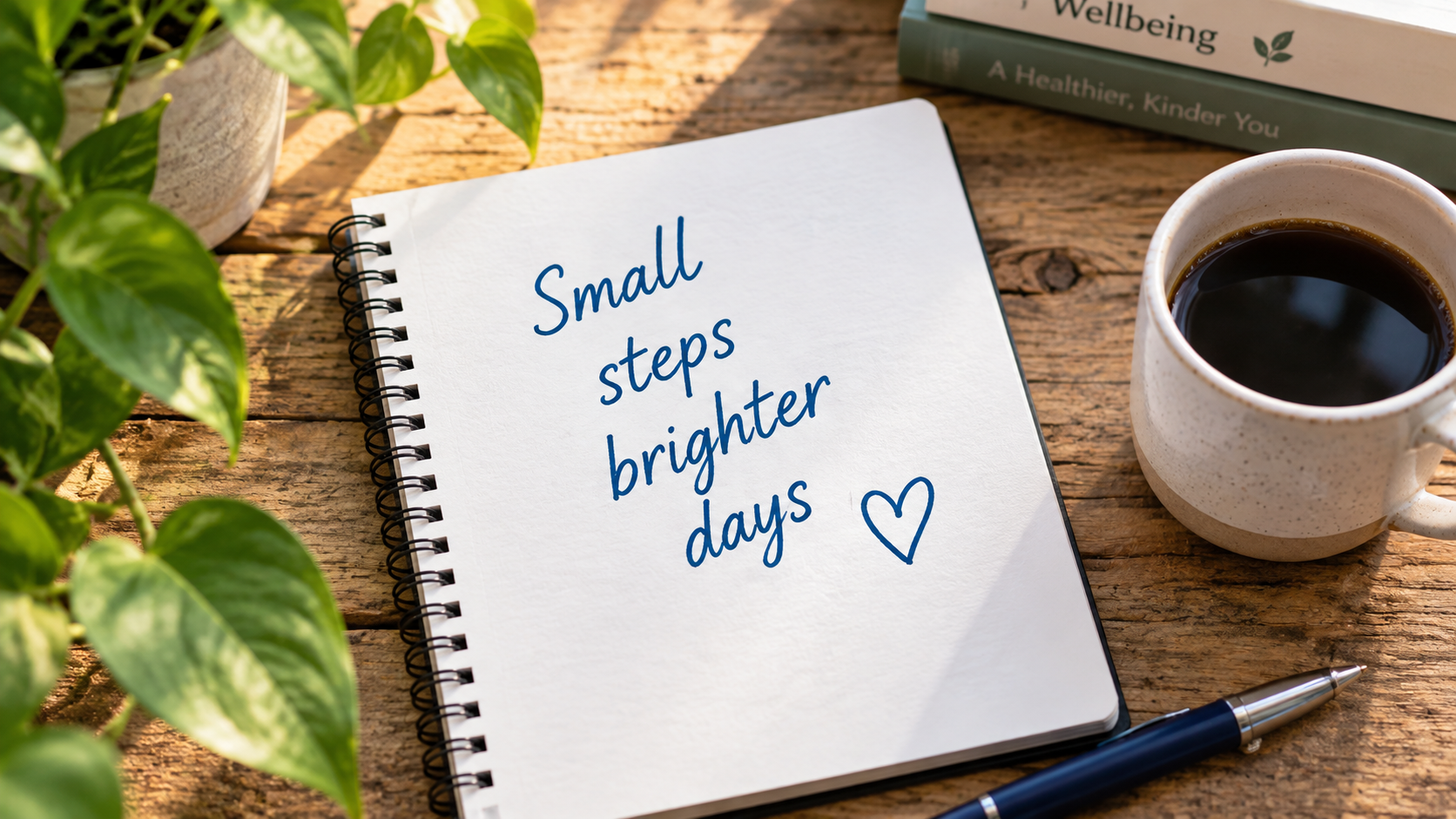
Small tools can make a difference
Looking after your wellbeing does not always require a major change.
Sometimes the most useful strategies are small things that make everyday life feel a little more manageable.
A practical tool might help you slow things down when you feel overwhelmed, organise your thoughts, reconnect with what matters to you or simply get through a difficult part of the day.
Not every strategy will work for every person. The aim is to build a collection of things you can draw on and work out which ones actually help you.
Start with what you need right now
When things feel difficult, it can be tempting to try to fix everything at once.
That usually makes the task feel even bigger.
Instead, ask yourself what would make the next hour or the rest of today slightly easier.
You might need rest. You might need to move your body, eat something, speak with somebody, finish one small task or step away from something that is becoming overwhelming.
Starting with the immediate need can make it easier to decide what to do next.
Break things into smaller steps
Large tasks can become much easier to approach when they are broken into smaller pieces.
Instead of thinking, “I need to sort my whole life out,” identify the smallest useful action you can take.
That could be opening an email without replying to it, putting one load of washing on, writing down three things you need to remember or making one phone call.
Small steps still count.
Progress does not have to feel dramatic to be meaningful.
Get things out of your head
Trying to hold everything in your mind at once can become exhausting.
Writing things down can create some space.
You might use a notebook, your phone or a simple list to capture tasks, worries, ideas or things you want to discuss later.
The goal is not to create the perfect organisational system.
It is simply to reduce the amount you are asking your brain to keep track of at one time.
Create a few reliable anchors
When life feels unpredictable, a few regular points in the day can provide some structure.
Your anchors do not have to be complicated.
They might include:
- getting up at roughly the same time
- having something to eat in the morning
- taking medication as prescribed
- going outside for a short period
- having a regular check-in with somebody
- doing one small household task
- creating a simple evening routine
You do not need a perfectly organised day.
A couple of reliable habits can be enough to give the day some shape.
Use grounding when things feel overwhelming
When thoughts or emotions are moving quickly, bringing your attention back to what is happening around you can sometimes help.
You might notice what you can see, hear and feel around you.
You could place your feet firmly on the floor, hold a cool drink, focus on your breathing or describe the room you are sitting in.
The purpose is not to make every difficult feeling disappear.
It is to give yourself something concrete to focus on while the intensity passes.
Make connection part of your toolkit
Wellbeing is not only about what you can do by yourself.
Connection can be a practical tool too.
That might mean messaging a friend, spending time with family, attending a group, speaking with a professional or having a conversation with someone who understands what you are going through.
You do not necessarily need advice.
Sometimes being able to say what is happening out loud can make things feel less tangled.
Notice what actually helps
A strategy is only useful if it works for you.
Pay attention to the things that leave you feeling even slightly calmer, clearer, more connected or more able to continue with your day.
It can also be useful to notice what consistently makes things harder.
Over time, you can begin to build your own understanding of what supports your wellbeing.
That personal knowledge is valuable.
Do not turn wellbeing into another test
There can be a lot of pressure to exercise perfectly, sleep perfectly, eat perfectly, meditate every day and maintain an ideal routine.
Wellbeing does not need to become another standard you feel you are failing to meet.
Some days you will have more capacity than others.
A useful strategy should support you, not give you another reason to criticise yourself.
If something is not helping, you are allowed to change it.
How peer support can help
A peer support worker can help you explore practical strategies in a collaborative way.
They may draw on their own lived experience where it is useful, but the focus remains on what works for you.
You might use a session to talk through what has been difficult, identify one area you would like to make easier and experiment with a few practical approaches.
You can then come back to what worked, what did not and what you want to try next.
There is no expectation that you need to have everything figured out.
Build your own wellbeing toolkit
Your wellbeing toolkit will probably change over time.
Some strategies may be useful during stressful periods but unnecessary at other times. New challenges may require new approaches.
The goal is not to collect as many techniques as possible.
It is to know that when things become difficult, you have a few options available and people you can turn to.
Small steps can make brighter days possible.